
System design simulator
Design it. Load it. Watch it break.
Put real components (EC2, EKS, RDS, Redis, Kafka, Lambda and 206 more) on a canvas, send millions of simulated users at them, and see where your architecture fails and why.
Free. No sign-up. Runs in your browser.
Not a diagram. A simulation.
- 01
Build
Choose from 212+ components across AWS, Google Cloud, Azure and open source. Each one comes with realistic limits: connections, partitions and concurrency.
- 02
Load
Every request is simulated with queueing theory. Utilisation, Little’s law, cache hit ratios and consumer lag are the numbers the engine actually computes.
- 03
Break
Kill nodes, add latency, cut links or fail a zone. You get the real error message, the numbers behind it and what to try next.
Then scale it to millions
Open the simulator →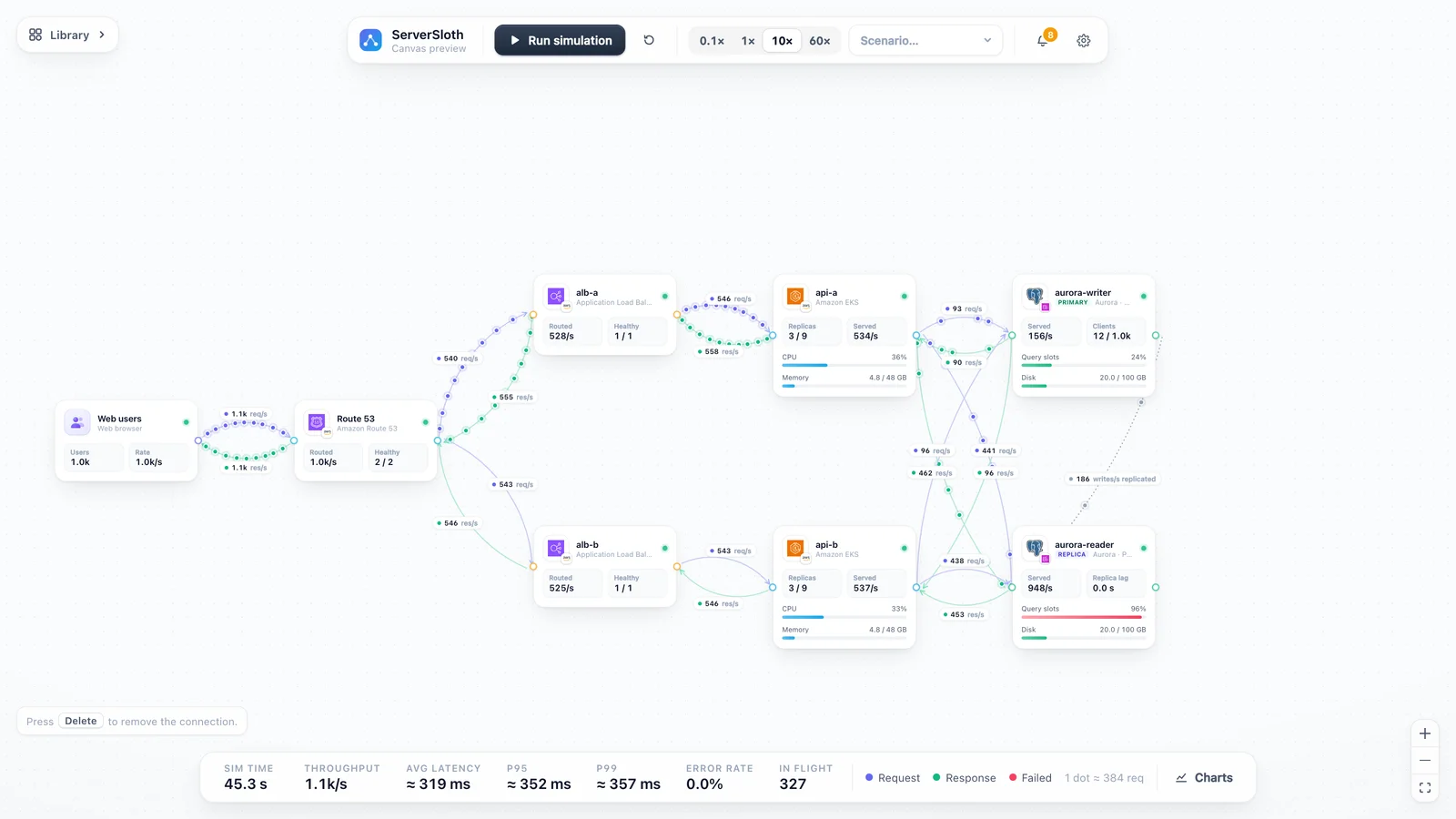
Start from a reference architecture
All templates →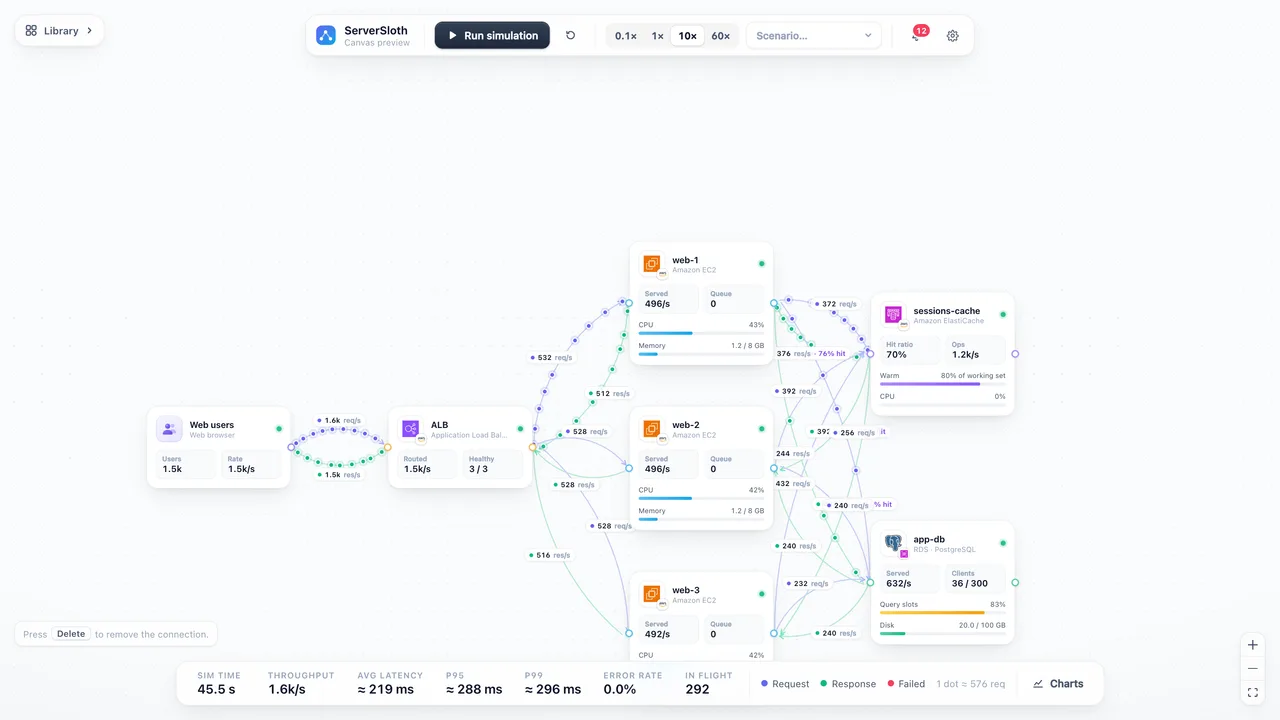 Startup
Cached web app
ALB → three EC2 servers using ElastiCache (cache-aside) in front of RDS PostgreSQL. At 60 s Redis is flushed.
 Scale-up
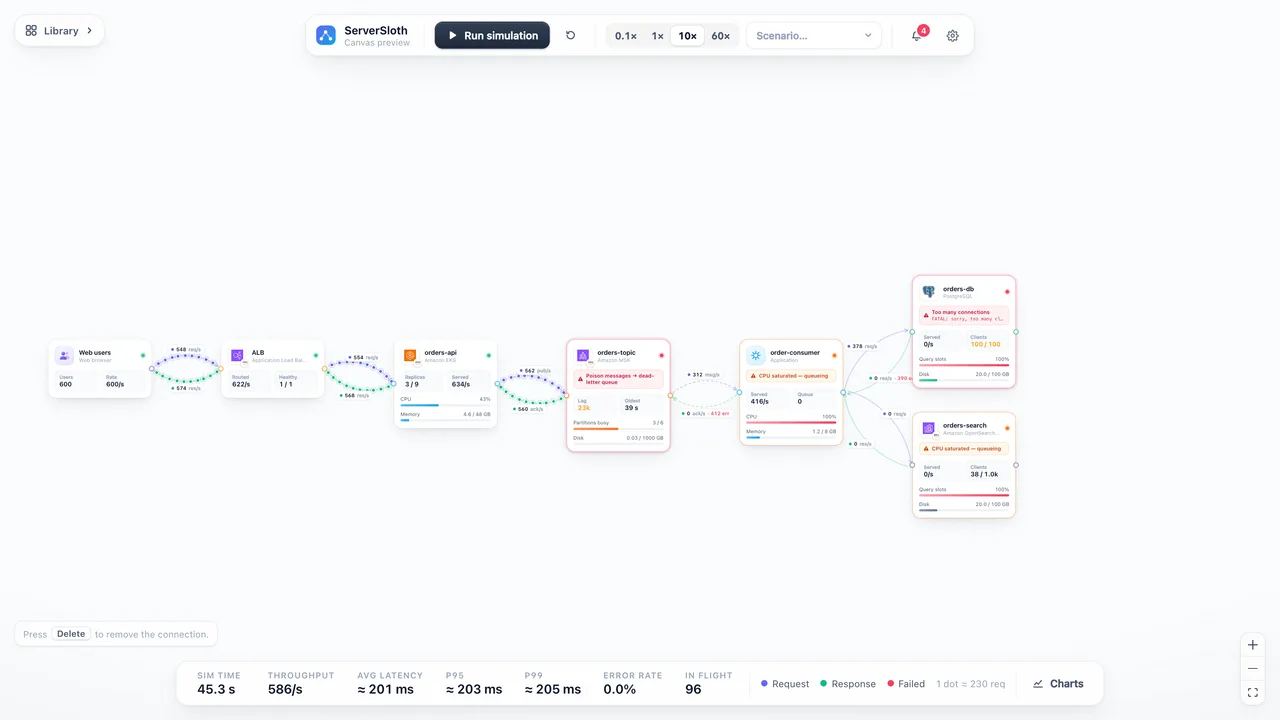
Event-driven microservices
ALB → EKS → Kafka (MSK, 6 partitions, 60 s retention) → consumers → PostgreSQL and OpenSearch.
 Global
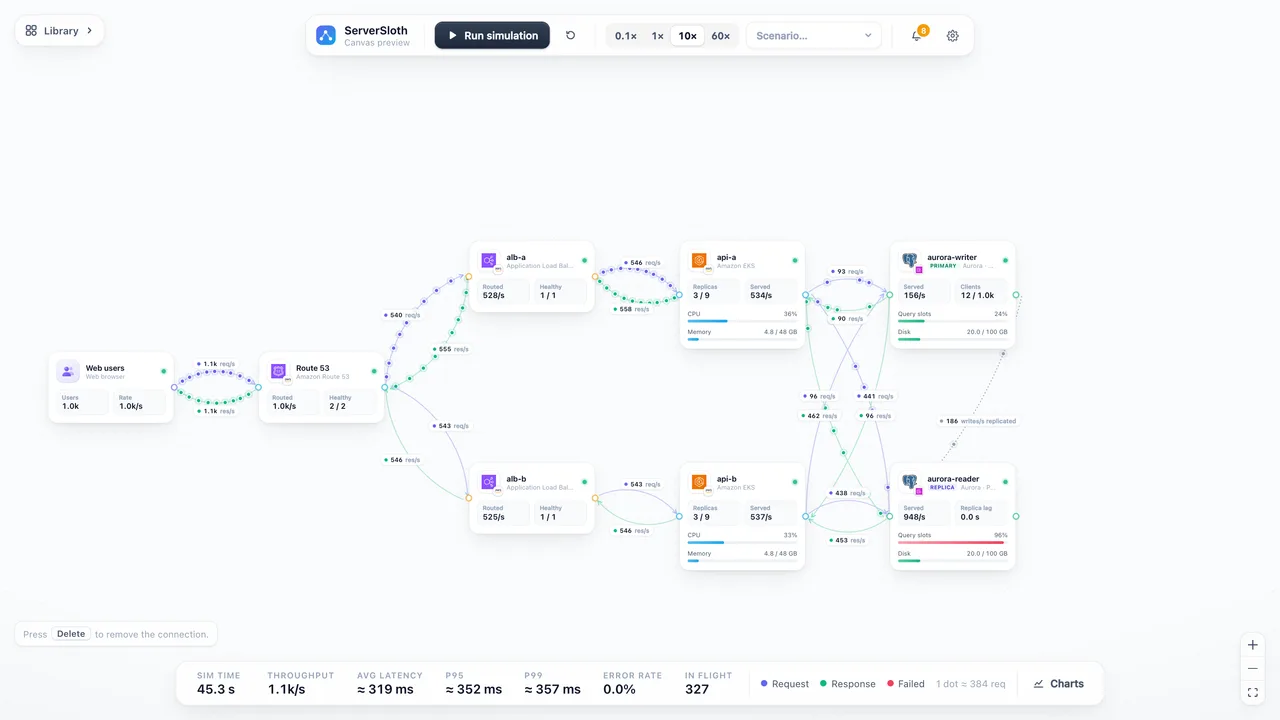
Multi-region
Route 53 → two zones, each with an ALB and EKS → Aurora writer in zone A with a replica in zone B. Zone A fails at 40 s.
Questions
What is ServerSloth?
ServerSloth is a free, browser-based system design simulator. You build an architecture from real components — servers, load balancers, databases, caches, queues and managed cloud services — send simulated traffic through it, and watch how it behaves and where it fails.
Is the simulation realistic?
Every component follows a documented model from queueing theory: utilisation, Little’s law, connection limits, cache hit ratios, partition limits and more. The models are simplified for learning, and each product says what it approximates.
Which cloud services can I use?
Over 200 components from AWS (EC2, EKS, RDS, Aurora, Lambda, SQS, DynamoDB…), Google Cloud, Azure, Cloudflare and open source (PostgreSQL, MySQL, Redis, Kafka, Nginx, Kubernetes…).
Is it useful for system design interviews?
Yes. Instead of only drawing boxes, you can see why a cache needs a fallback plan, why databases need connection pooling, or why Kafka parallelism is limited by partitions — with numbers you can quote.
Do I need an account?
No. ServerSloth runs entirely in your browser and saves your canvas locally.